
A few years ago, AI recruitment mostly meant a keyword filter bolted onto an applicant tracking system – crude, easy to game, and not particularly smart. That’s changed a lot. AI hiring tools now parse resumes with genuine semantic understanding, score candidates with explainable reasoning, source passive talent across hundreds of millions of profiles, and even analyze video interviews. The technology has gotten good enough that it’s reshaping how IT recruitment actually works, not just speeding up the paperwork around it.
That said, “AI is changing recruitment” isn’t the same as “AI has solved recruitment.” The honest picture involves real gains, real limitations, and a few new problems that didn’t exist before AI showed up on both sides of the hiring table.
What AI Recruitment Actually Covers Now
It’s worth being specific here, because “AI recruitment” gets used as a catch-all term for a handful of genuinely different capabilities:
- Resume parsing and screening – extracting structured data from resumes and scoring candidates against job requirements.
- Semantic matching – understanding that “led a team” and “managed a team” mean roughly the same thing, rather than relying on exact keyword matches.
- Candidate sourcing – searching across massive candidate databases to surface passive talent who aren’t actively applying.
- Video interview analysis – reviewing recorded interviews for communication patterns and content.
- Scheduling and engagement automation – handling the logistical back-and-forth that used to eat up huge amounts of recruiter time.
Each of these solves a different bottleneck, which is why most recruiting teams end up using several AI tools together rather than one all-in-one platform.
How AI Resume Screening Actually Works
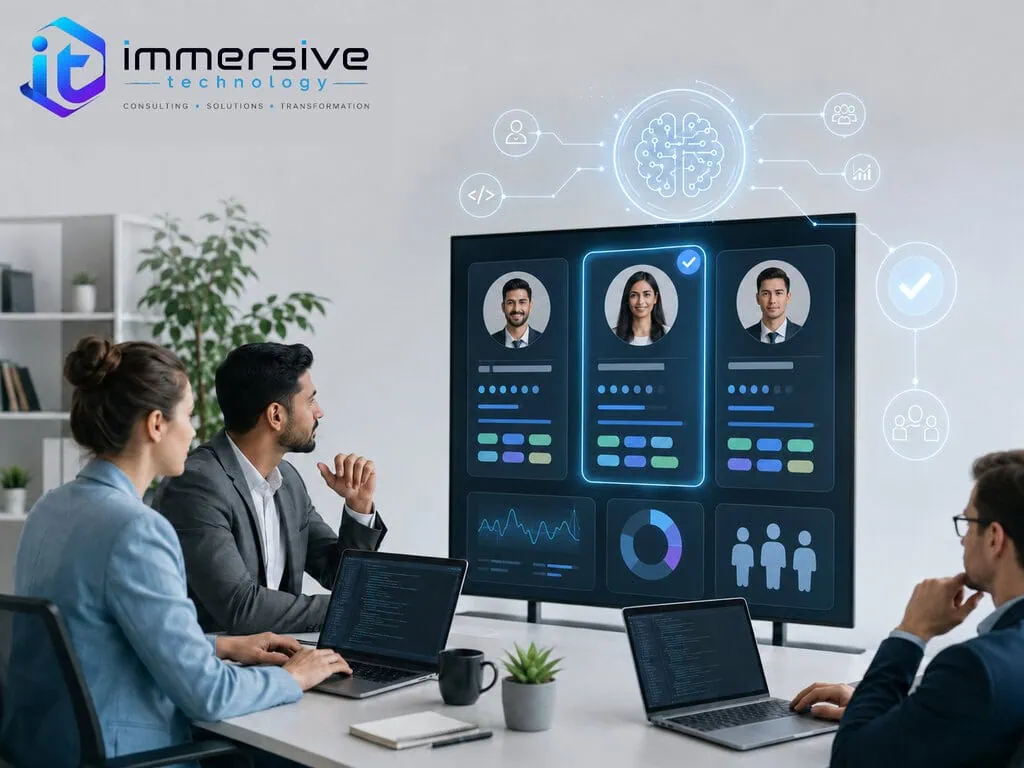
AI resume screening has moved well past simple keyword matching. Modern tools parse unstructured resume data – skills, experience, education, certifications – into structured profiles, then use semantic matching to recognize related terms and equivalent experience even when the exact wording differs. From there, candidates get scored and ranked, with many platforms now offering explainable reasoning behind each score rather than a black-box number, and auto-sorting applicants into categories like approved, pending review, or skipped.
The scale this unlocks is hard to replicate manually. A large share of applications never meet the basic requirements of a role in the first place, and manual screening of every single one simply doesn’t scale once application volume climbs – which, in competitive tech hiring, it usually does.
The Efficiency Gains Are Real, But Worth Sourcing Carefully
Most surveys on AI screening report meaningful drops in screening time and strong satisfaction among recruiters using these tools. That said, it’s worth noting a lot of this data comes from vendors and staffing agencies with a commercial interest in AI adoption – so treat headline efficiency numbers as directionally useful rather than gospel, and validate them against your own hiring pipeline rather than assuming they’ll transfer perfectly.
Where AI Recruitment Still Falls Short
This is the part that gets glossed over in a lot of vendor marketing. AI hiring tools are genuinely useful, but they’re not a neutral, bias-free replacement for human judgment – and treating them that way creates its own risks.
Bias Doesn’t Disappear – It Just Moves
AI models learn from historical hiring data, which means they can inherit the same biases that shaped who got hired in the past, just expressed through a more opaque scoring system. Some vendors market strong diversity-improvement numbers, but a lot of those claims lack solid independent backing and should be treated as something to test against your own results, not assumed as fact. If you’re using AI screening, it’s worth periodically auditing who gets filtered out and why, rather than trusting the score blindly.
AI Is Now on Both Sides of the Hiring Table
Here’s the twist that makes 2026 recruitment genuinely different from a few years ago: candidates are using AI tools too – to write resumes, tailor applications instantly to each job description, and in some cases, to complete assessments they didn’t actually do the thinking for themselves. This has made resume inflation and application fraud a bigger issue than it used to be, and it’s part of why trust in traditional hiring signals has eroded somewhat. We covered this shift in more detail in our post on IT recruitment trends every CTO and HR leader should know, where the growing gap between polished applications and verified real skill is one of the defining stories of the year.
The practical result is a bit ironic: AI screening tools help you process more applications faster, but a growing share of those applications were also assembled with AI help – meaning speed alone doesn’t solve the deeper verification problem.
Using ChatGPT and AI Assistants as a Recruiter, Practically
Beyond dedicated AI hiring platforms, general-purpose AI assistants like ChatGPT have become a quiet but genuinely useful part of many recruiters’ day-to-day toolkit. A few practical, low-risk uses:
- Drafting job descriptions faster, then editing for accuracy and tone rather than starting from a blank page.
- Structuring interview questions around specific skills or seniority levels, which pairs well with a more deliberate interview framework – our post on technical interview questions every hiring manager should ask covers what a strong question set actually looks like.
- Summarizing lengthy candidate notes from multiple interviewers into a clearer comparison.
- Drafting candidate communication – rejection emails, offer follow-ups, and status updates – to keep tone consistent and responses fast.
The common thread across all of these: AI assistants are strongest as a drafting and organizing tool, not as the final decision-maker.
Where Human Judgment Still Wins – And Probably Always Will
There’s a meaningful difference between what AI can screen for and what actually predicts whether someone will succeed on a specific team. Culture fit, communication style under pressure, and genuine technical judgment are still best assessed by people, in real conversation, not by a scoring algorithm working from a resume alone.
This is especially true for technical roles, where the depth of someone’s actual skill often only becomes clear through structured, live evaluation. Our post on how to evaluate a software developer beyond their resume covers exactly this gap – the methods that reveal real capability that no resume, AI-scored or otherwise, can fully capture on its own.
Building a Responsible AI Recruitment Stack
If you’re adopting AI hiring tools, a few practical principles tend to keep the process both efficient and fair:
- Use AI to narrow the funnel, not to make final decisions. Let it do the heavy lifting on volume; keep humans in the loop for anything approaching a yes-or-no call.
- Audit your screening results periodically. Check who’s getting filtered out and whether that pattern holds up under scrutiny.
- Combine AI screening with skills-based verification. A high match score on paper still benefits from a practical assessment or structured interview to confirm it.
- Be transparent with candidates about where AI is used in your process – it builds trust and heads off suspicion that can otherwise damage your employer brand.
- Reassess your tools regularly. This space is moving fast enough that a tool that made sense a year ago may already be behind the current best practice.
Where This Fits Into Your Broader Hiring Strategy
AI recruitment tools are genuinely reshaping the operational side of hiring, but they work best as part of a broader, well-considered strategy rather than a shortcut around it. If you’re rethinking how AI fits into your team’s hiring process, our services and solutions pages outline how we help organizations across different industries build hiring processes that combine the right technology with sound human judgment. You can also browse our full blog for more on hiring strategy, learn more about us, or get in touch if you’d like to talk through your specific setup.
Conclusion
AI recruitment has genuinely changed IT hiring – faster screening, smarter candidate matching, and less manual grunt work for recruiters. But it’s changed the candidate side of the equation too, which means speed alone isn’t the whole win it looks like on paper. The teams getting the most out of AI hiring tools right now are the ones using them to remove friction from the process, while keeping real human judgment firmly in charge of the decisions that actually matter.
Frequently Asked Questions
It covers resume parsing and scoring, semantic candidate matching, passive candidate sourcing, video interview analysis, and scheduling or engagement automation – each solving a different part of the hiring bottleneck.
It can be, since AI models often learn from historical hiring data that may carry the same biases as past decisions. Vendor claims about bias reduction should be tested against your own results rather than taken at face value.
Yes, and this is becoming more common – candidates increasingly use AI to tailor applications instantly or complete assessments, which is part of why verifying real skill has become more important, not less.
Yes, particularly for drafting job descriptions, structuring interview questions, summarizing interviewer notes, and writing candidate communications – though final hiring decisions should stay with human judgment.
No. AI tools work best narrowing a large applicant pool efficiently, while final decisions – especially around culture fit and technical judgment – are still better handled by people.
Match the tool to your specific bottleneck – screening, sourcing, or interview analysis – and prioritize platforms that offer explainable scoring and integrate with your existing ATS.